Materials & Tools
The Best Budget Watercolor Starter Kit and What to Skip
Build a solid watercolor starter kit without overspending. Learn which budget supplies actually work and what cheap options to avoid.
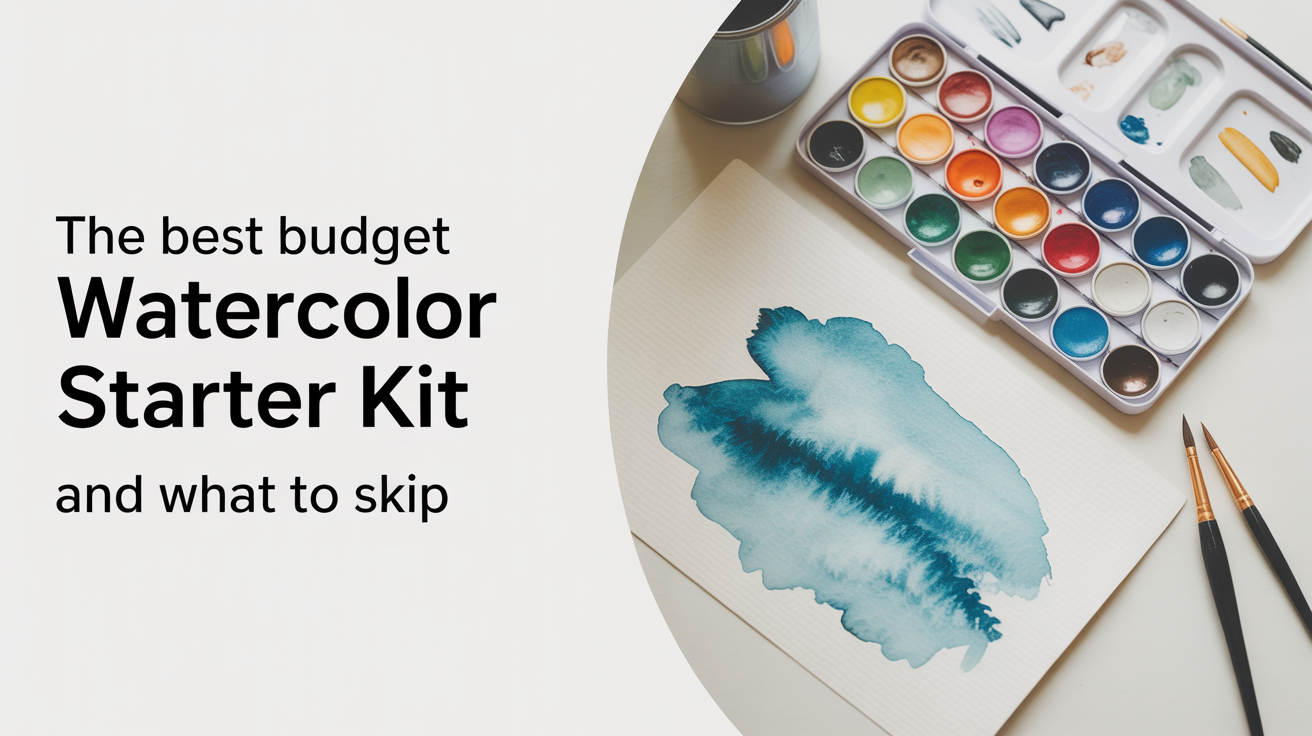
Starting watercolor doesn't have to cost much. A workable kit runs $30 to $50 if you know what matters and what's just filler. The hard part is that budget supply ranges vary wildly in quality, and buying the wrong things early is what makes people quit before they really get going.
Here's what to actually buy, what to skip, and why.
At a Glance
- Budget for paint, brushes, paper, and water containers first; everything else can wait.
- Paper matters more than paint. Buy 140 lb (300 gsm) cold-press before you upgrade anything else.
- A 12-color Cotman or Van Gogh pan set beats any $4 craft-store set and most 36+ color "value" sets.
- Three synthetic rounds (sizes 3-4, 6, and 10) cover roughly 90% of beginner subjects.
- Skip boxed "everything included" kits under $15; the paper and brushes are usually the first things you'll replace.
- A complete, usable kit costs $45 to $50 and lasts a hundred practice sessions before you need to upgrade anything.
What a beginner kit actually needs
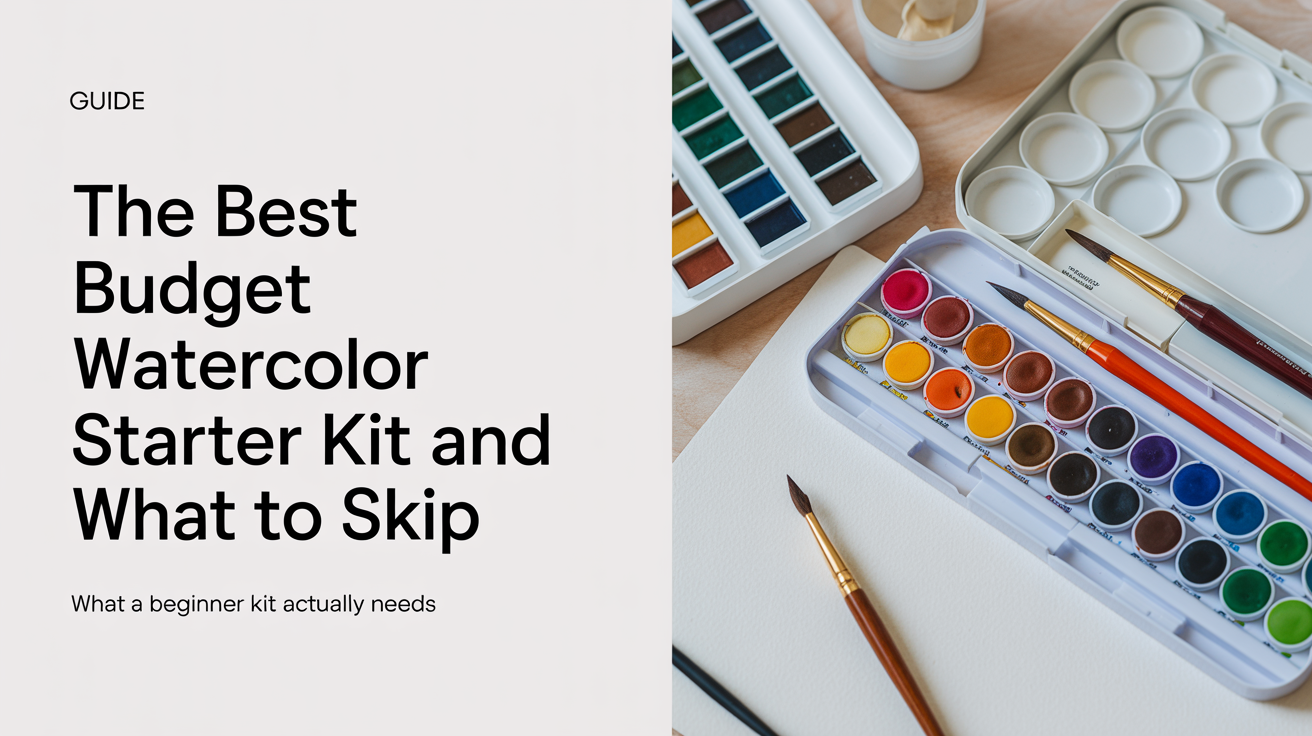
You need four things: paint, brushes, paper, and something to hold water. That's genuinely it. Everything else (palette knives, masking fluid, special mediums) can wait until you know whether you like this enough to keep going.
The priority order matters too. Paper and paint carry the most weight. A good sheet of 140 lb (300 gsm) cold-press paper with mediocre paint will give you better results than student-grade paper with professional paint. Most beginners get this backwards, spending on a fancy paint set and grabbing whatever paper pad is cheapest, then wondering why their washes look blotchy and streaked no matter how careful they are.
Paint
For your first set, a small pan or tube set in the $12 to $20 range from Cotman (Winsor & Newton's student line), Van Gogh, or Arteza's artist-grade range will give you workable pigment. Avoid the $4 pans from craft stores: the color is chalky, lifts poorly, and won't teach you how watercolor actually behaves.
The difference between student and professional grade comes down to pigment load, not chemistry. Student lines like Cotman generally use the same pigment families as their professional counterparts but cut them with fillers and extenders to hold the price down, which is why the color feels a shade less vivid straight from the pan. Reviewers who test paint by pigment concentration and handling, including the long-running handprint watercolor brand comparisons, note that student paints trade some strength and lightfastness for cost, which is a reasonable trade while you're still learning to mix rather than buying pure pigment quality.
You don't need a 48-color set. A dozen colors or fewer is better. You'll actually learn to mix if you start small. Look for sets that include something close to ultramarine blue, phthalo blue or cerulean, a warm yellow like hansa or cadmium yellow hue, burnt sienna, and a neutral like payne's grey. From those five you can mix most things a beginner will want to paint.
If you go with tubes, three to six tubes is plenty. Squeeze a pea-sized amount into a white palette (or a cheap ceramic plate) and let them dry. You now have a pan set.
For more on how pans and tubes compare in practice, watercolor paint for beginners: tubes vs pans explained covers the tradeoffs in detail.
Paper
This is where most beginners underinvest. Thin, smooth paper (anything below 90 lb, or the "sketch" pads that say "multi-media") will buckle the moment you wet it, pill when you try to lift color, and generally fight you at every step.
Buy 140 lb (300 gsm) cold-press. Strathmore 400-series, Canson XL watercolor pads, or Fabriano Studio are all fine for learning and cost $10 to $18 for a pad of 12 to 15 sheets. Arches and Fabriano Artistico are the professional standards, but they cost twice as much and you don't need them yet. Independent paper testing, including the handprint guide to watercolor paper brands and weights, backs up what most beginners find by trial and error: mid-weight cold-press sheets from the mainstream student brands hold a wash evenly and survive normal beginner mistakes like re-wetting an area twice, while thinner "multi-media" papers pill and warp under the same treatment.
Cold-press texture (lightly textured, not rough) suits most beginner subjects. Hot-press (smooth) is harder to control. For a full breakdown of paper types, watercolor paper explained: cold press, hot press, and rough is worth reading before you buy.
Brushes
Three brushes is enough. A size 10 round for large areas, a size 6 round for medium work, and a size 3 or 4 round for smaller details. That covers 90% of what a beginner needs.
Synthetic rounds in the $3 to $6 each range (Princeton Neptune, Princeton Select, or any generic "synthetic sable") hold water well and spring back to a point. Avoid the cheap stiff brushes in starter kits where the bristles splay after one wash. Also skip the flat "variety packs" with six different shapes you've never heard of.
If you want help choosing beyond those three basics, how to choose your first watercolor brushes goes into detail.
Water containers and palette
Use two jars (mason jars, deli containers, old mugs). One for rinsing your brush, one for clean water to mix colors. This is genuinely important: a single jar turns murky fast and muddies your mixes. Change the rinse water as soon as it goes cloudy grey rather than waiting until it's opaque; a jar that's already murky can tint a "clean" mix without you noticing until the wash dries.
For a palette, a cheap white plastic one with wells works fine, or use a white ceramic plate. The color of the mixing surface matters: white shows your tones accurately.
What to skip (and why)
Some things are not worth buying until later. Others aren't worth buying at all.
Cheap starter kits with everything included. The boxed "complete kits" under $15 that come with brushes, paints, paper, a palette, and an easel are almost always a false economy. The paper is too thin, the brushes splay, and the paints are more filler than pigment. You'll spend more replacing them than if you'd bought decent individual items to begin with.
Large color sets. A 36 or 48-color pan set sounds appealing but most of the colors are redundant. You'll grab a pre-mixed orange instead of learning to mix one, and you'll never learn which pigments granulate or how transparent each one is. Start smaller on purpose.
"Watercolor pencils" as a substitute. Watercolor pencils are a different medium and useful in their own right, but they don't teach the same skills as wet brush work. If you want to learn watercolor, start with paint.
Masking fluid. It's useful, but it's also easy to ruin brushes with it if you forget to protect them first. Learn to save your whites by painting around them before adding tools that compensate for that skill. More on that approach at how to save the white of the paper in watercolor.
Professional-grade paint right away. Single-pigment professional tubes like Daniel Smith or Schmincke Horadam are excellent, and you will want them eventually. But the jump from Cotman to Daniel Smith is smaller than the jump from bad paper to good paper. Save the upgrade for when you know which colors you actually reach for.
A buy-this / skip-that reference
| Item | Buy this | Skip this |
|---|---|---|
| Paint | Cotman 12-pan set, Van Gogh, Arteza artist grade | Craft-store $4 pans, any set under $10 |
| Paper | Strathmore 400, Canson XL, Fabriano Studio (140 lb) | Multi-media pads, "sketch" watercolor paper under 90 lb |
| Brushes | Princeton Neptune or Select rounds (sizes 6, 10) | Stiff synthetic variety packs in starter kits |
| Water jars | Two mason jars or deli containers | Single-jar setups |
| Palette | White plastic palette with wells, or ceramic plate | Colored or dark plastic palettes |
| Starter kits | None recommended | $10-$15 "everything included" box sets |
Five colors that cover almost everything
A dozen pans sounds small, but you really only lean on a handful of colors while you're learning to mix. This is the short list worth prioritizing if your set lets you choose, or the list to check your set against if it's pre-selected.
| Color | Role in the mix | Why it earns a spot |
|---|---|---|
| Ultramarine blue | Cool blue, shadows, distant color | Granulates nicely, mixes clean purples and greys |
| Phthalo blue or cerulean | Second blue for skies and greens | Phthalo is intense and stains; cerulean is softer and more opaque |
| Hansa yellow or cadmium yellow hue | Warm, clean yellow | Mixes bright greens and oranges without turning muddy |
| Burnt sienna | Warm earth tone | Pairs with ultramarine for natural greys and browns |
| Payne's grey or a mixed neutral | Darkest values, toning down colors | Lets you darken a mix without buying black |
Two blues, one yellow, one earth tone, and one neutral gives you a working range for landscapes, still life, and most beginner subjects without the redundancy of a 36-color set.
Building the kit for under $50
Here's a realistic shopping list that comes in around $45 to $50 at most art supply retailers:
- Cotman 12-pan set: $12 to $15
- Strathmore 400 watercolor pad (9x12, 12 sheets): $10 to $13
- Princeton Neptune round size 10: $6 to $8
- Princeton Neptune round size 6: $5 to $7
- Two mason jars or containers: free, from your kitchen
- White plastic palette: $3 to $5
That's everything you need to get a hundred sessions in. Once you know you're sticking with it, you can upgrade one thing at a time, starting with paper.
A few tips before your first session
Keep expectations calibrated. Watercolor dries 20 to 30% lighter than it looks when wet. That wash you thought was rich and saturated will look pale and washed out when it dries. This isn't a mistake; it's just how the medium works, and you account for it by going darker than feels right.
Work light to dark. You can add more pigment but you can't easily take it back. Start with watery, tea-consistency mixes and build up.
Let layers dry fully between passes. A hair dryer helps if you're impatient, but touching a layer that's still wet will cause blooms and backruns. (They can be beautiful, but they should be intentional.)
Practice first on a scrap piece of the same paper. Paper texture affects how paint flows, and five minutes on a scrap saves you from ruining something you were excited about. If you notice your test scrap warping even slightly under a single wash, that's a sign the paper is too thin, not that you did something wrong.
Frequently asked questions
Is Cotman paint good enough for a beginner?
Yes, genuinely. Cotman is Winsor & Newton's student range and uses the same pigment families as their professional line, just with some pigment extenders to keep the price down. The colors mix predictably, lift reasonably well, and behave like proper watercolor. It's a solid place to start. When you're ready to upgrade, you'll know exactly which colors to buy in professional grade because you'll know what you reach for.
Can I use regular sketch paper instead of watercolor paper?
Not really. Regular sketch or copy paper can't absorb the water load. It will warp, pill when you try to lift or rework an area, and the paint will sit on top rather than soaking in. Even a mid-grade student watercolor pad (140 lb) behaves completely differently. Paper is the upgrade that makes the biggest difference early on.
Do I need an easel?
No. Most watercolorists work flat or at a slight incline on a tabletop. A flat surface lets you control blooms and keep washes from running where you don't want them. An easel can be useful once you're working larger or standing, but it's not a beginner need.
How many brushes do I actually need?
Three rounds (a 10, a 6, and a 3 or 4) covers almost everything. If you had to start with just one, a size 8 or 10 round with a good point can paint both large areas and reasonable detail. Variety in brush shapes matters much less than having one brush that holds water well and returns to a point.
What if I want to try pans vs tubes first before committing?
A 12-pan Cotman set is a low-stakes way to start. If you find you're going through particular colors fast, that's a sign to buy that color in tube form. The pan set stays useful as a travel palette even after you've moved on to tubes for studio work.
Should I buy single colors or stick with a pre-made set?
Start with a pre-made set. Sets are cheaper per color and are usually chosen to cover a workable range. Once you notice you're always reaching for one particular blue or mixing the same green from scratch, that's the point to start buying single tubes to fill the gap rather than replacing the whole set.
Is it worth buying paint in a metal tin vs a plastic palette box?
Not for a first kit. Metal tins look nicer and travel a little better, but a $12 plastic pan set with the same pigments performs identically on paper. Spend the price difference on paper instead; it does more for your results than the container your paint comes in.