Materials & Tools
Watercolor Paper Explained: Cold Press, Hot Press, and Rough
Watercolor paper explained: learn the real differences between cold press, hot press, and rough so you buy the right surface first time.
The paper you paint on matters more than almost anything else in your kit. Cheap copy paper will buckle, bleed, and pill under your brush, making a simple wash feel like a fight. Watercolor paper is made differently, and the surface texture (called the "tooth") changes how paint settles, blooms, and dries in ways that will either help you or trip you up. This guide explains the three main watercolor paper types so you can pick the right one before you spend a cent.
At a Glance
- Cold press (moderate texture) is the standard beginner choice: it handles washes, granulation, and lifting well.
- Hot press (smooth) suits fine detail and pen-and-wash but fights loose, wet-on-wet painting.
- Rough (heavy tooth) is a specialty surface for dry-brush sparkle; skip it until you know cold press well.
- Buy 140 lb (300 gsm) for your first purchase. Lighter paper buckles; heavier paper costs more than a beginner needs.
- "Sizing" (a gelatin or synthetic coating) is what actually controls how fast water sinks in, not just weight or texture.
- Cotton paper costs more but takes more layers and lifts more cleanly than wood-pulp (cellulose) paper.
Why paper surface matters so much
When water hits a surface, it either pools in tiny valleys or slides off a smooth plane. Watercolor paper is designed to handle a lot of water without warping or tearing, but the surface texture goes further than that: it controls how pigment settles, whether granulating colors like ultramarine and burnt sienna separate into their characteristic texture, and how forgiving the paper is when you want to lift or correct wet paint. Cold-pressed sheets give the moderate texture most instruction assumes, while hot-pressed sheets are ironed nearly flat for a smoother surface.
There is a second, less-talked-about factor: sizing. Paper mills coat the sheet, inside the fibers and often on the surface too, with gelatin or a synthetic resin. Sizing exists specifically to slow down absorption, curbing the fibers' natural tendency to wick water sideways by capillary action. A heavily sized sheet gives you more open time to move paint before it locks in; a lightly sized sheet (sometimes labeled "high absorbency" for students) grabs the pigment fast and forgives less. This is why two 140 lb cold-press papers from different brands can feel completely different under the same brush. If a paper feels unusually "thirsty," under-sizing, not weight, is usually the reason.
The weight of the paper matters too. Standard watercolor paper comes in 90 lb (190 gsm), 140 lb (300 gsm), and 300 lb (640 gsm). As a beginner, 140 lb (300 gsm) cold-press is the standard starting point and what most instruction books assume you are using. Lighter paper buckles badly unless you stretch it first. The heaviest weights barely buckle at all but are expensive. For everyday practice, 140 lb is the sweet spot.
Paper is also made in one of two ways: cotton rag or wood pulp (often labeled "cellulose"). Cotton paper is more expensive but more stable, more forgiving to lifting, and more durable over time. Wood-pulp paper is fine for practice and learning. Brands like Arches, Fabriano Artistico, and Fluid 100 are cotton; brands like Canson XL and Strathmore 400 are cellulose. You can absolutely learn on cellulose paper. Just know that some techniques, particularly wet lifting and glazing, behave better on cotton.
Cold press: the best watercolor paper for beginners
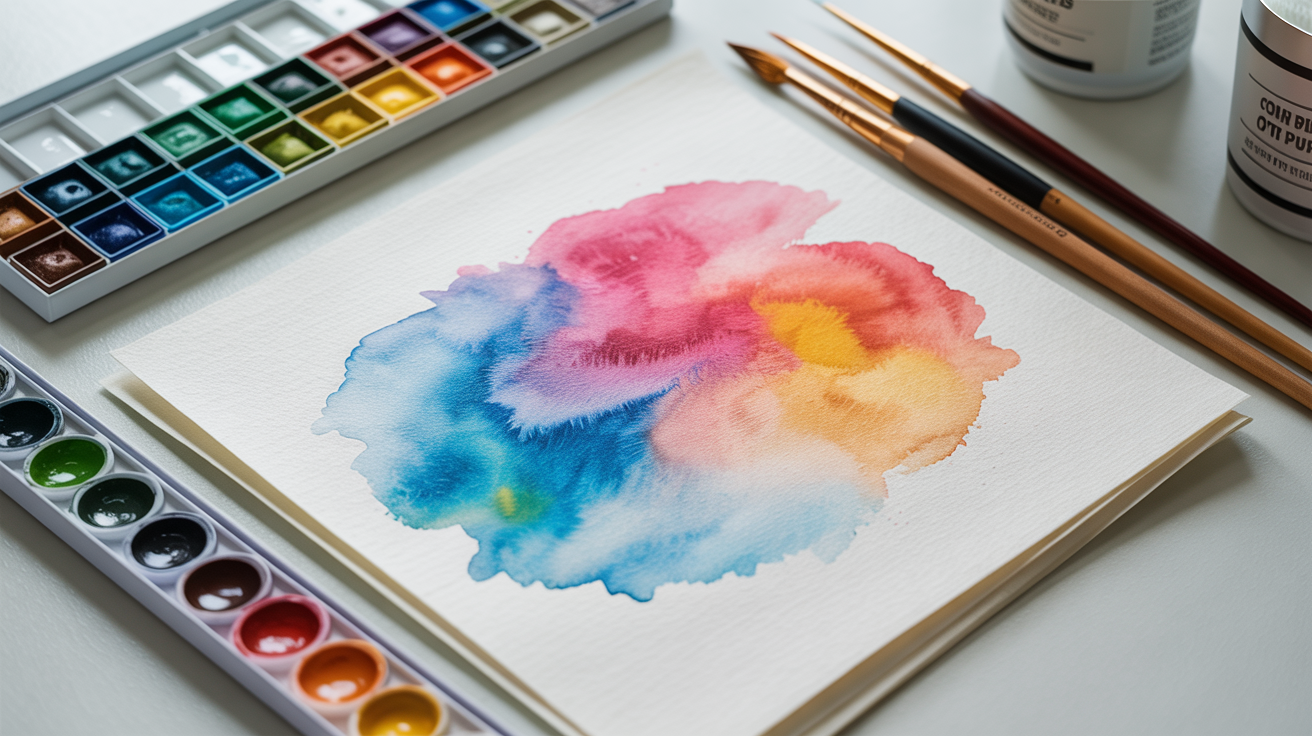
Cold-press paper has a moderate, slightly bumpy texture. The name comes from the manufacturing process: after the pulp is formed into sheets, the paper is pressed through cold metal rollers, which leaves a gentle grain on the surface.
That texture does a lot of useful things. Paint sits in the tiny peaks and valleys rather than spreading uncontrollably, giving you a bit more time to move it before it locks. Granulating pigments like ultramarine blue, cerulean, and raw sienna settle into the tooth beautifully, producing the gentle mottled effect that makes watercolor look like watercolor. Wet-on-wet washes (dropping wet paint into a wet area) bloom softly rather than racing across the paper in a way that's hard to control.
Cold press is also more forgiving when you want to lift paint. While wet, you can blot with a clean brush or tissue to pull color back. Even when dry, cold press accepts gentle scrubbing with a damp brush or a stiff fan brush better than hot press does.
If you are just starting out, cold-press 140 lb paper is the right choice. Period. Most tutorials, including those in books like "Watercolor for the Absolute Beginner" by Mark Willenbrink, assume a cold-press surface. Strathmore 400 cold press is a decent cellulose option. Arches 140 lb cold press in block form is worth the extra cost once you know you enjoy the medium. Blocks (sheets glued on all four edges) stay flat without stretching and are beginner-friendly.
Hot press: smooth surface for detail and illustration
Hot-press paper goes through rollers heated to a high temperature, which irons the surface nearly flat. The result is a very smooth sheet with little texture.
On hot press, paint spreads fast and pooling is unpredictable. Wet-on-wet work is harder to control because there are no tiny valleys to hold the water in place. Granulating pigments look strange on hot press because they have nowhere to settle. Large flat washes can dry unevenly, showing streaks and tide marks.
That said, hot press excels at a specific kind of work: fine detail, botanical illustration, calligraphy, and tight pen-and-wash drawings. If you want to paint intricate feathers, delicate lettering, or tiny architectural sketches, hot press rewards you. A round size 2 or 3 brush on hot press gives you a line as clean as any ink marker.
For beginners painting loose landscapes, flowers, or abstracts, hot press is the wrong surface. The paint moves too fast and corrections are harder. It makes sense once you have a feel for how watercolor moves on a textured surface first.
Rough: texture-heavy and expressive
Rough paper is pressed the least, leaving a pronounced, irregular texture. The hills and valleys are deep enough to see and feel with your fingertip.
Drag a loaded flat brush quickly across rough paper and the paint only hits the peaks, leaving white paper showing in the valleys. This is called "dry brush" and it produces a sparkle effect that painters use to suggest glittering water, rough bark, or stone. On cold press, dry brush is possible but subtler. On rough, it's dramatic.
The downside is control. Fine detail disappears into the texture. Smooth gradients are harder to achieve because paint pools unevenly. Writing or fine lines are nearly impossible without fighting the paper. Rough paper is expressive and painterly but not great for precision.
Most rough watercolor paper is 140 lb or heavier. It is a specialty choice. Many experienced watercolorists love it; many never use it. As a beginner, you don't need it yet.
Comparison of the three paper surfaces
| Surface | Texture | Best for | Hardest for |
|---|---|---|---|
| Cold press | Moderate grain | Landscapes, flowers, most beginner subjects | Nothing specific; it handles most things |
| Hot press | Nearly smooth | Fine detail, illustration, pen-and-wash | Loose washes, granulating pigments |
| Rough | Heavy grain | Dry-brush effects, expressive mark-making | Fine lines, smooth gradients, detail |
| (All) 140 lb | Medium weight | Everyday painting without stretching | Very large sheets may still buckle |
A note on weight: any surface comes in different weights. A 300 lb rough sheet behaves differently from a 90 lb rough sheet even though both are "rough." When people compare surfaces, they usually assume the same weight. For a fair comparison, stay at 140 lb across all three while you experiment.
Sizing and open working time by paper type
Because sizing has such a large effect on how paper feels, it helps to see it laid out against the surfaces above. These are typical ranges, not guarantees. Individual brands vary.
| Paper property | Lightly sized (student) | Standard sizing (most 140 lb) | Heavily sized (premium cotton) |
|---|---|---|---|
| Open working time before paint sets | 15-30 seconds | 30-60 seconds | 45-90 seconds |
| Lifting after fully dry | Poor to fair | Fair to good | Good to excellent |
| Risk of "pilling" (fibers balling up under scrubbing) | High | Moderate | Low |
| Typical brands | Canson XL, cheap pads | Strathmore 400, Fabriano Studio | Arches, Fluid 100, Fabriano Artistico |
If your washes keep drying before you finish blending, that is often a sizing problem rather than a skill problem. Working faster helps, but switching to a more heavily sized sheet buys you real time.
Blocks, pads, and loose sheets: which format should you buy?
Watercolor paper comes in a few formats and it's worth understanding what you're getting.
Blocks are sheets glued on all four edges. You paint on the top sheet, let it dry completely, then slip a butter knife or palette knife around the edge to release the finished painting. Because the edges are held, the paper stays flatter while you work. For beginners who don't want to stretch paper, a block is the easiest option.
Pads are bound on one edge only. The paper can buckle as it gets wet. Lighter weights (90 lb) buckle badly. At 140 lb the buckling is manageable for small paintings (up to about 9"x12"), especially if you tape the edges to a board. Pads are cheaper per sheet than blocks.
Loose sheets are single large sheets (often 22"x30") you cut to size yourself. They require stretching or taping unless they're very heavy. More economical if you paint in volume.
For your first purchase, a cold-press 140 lb block in 9"x12" is the easiest starting point. Arches, Fluid 100, and Fabriano Artistico are reliable brands. Canson XL or Strathmore 400 Series are fine for practice while you decide if watercolor is for you.
Cost per sheet is worth doing the math on before you buy. A 12-sheet 9"x12" block of Arches 140 lb cold press typically runs $30-40, or roughly $2.50-3.30 a sheet. A 22"x30" loose sheet of the same paper costs about $10-12 and, cut into six 9"x12" pieces, works out closer to $1.70-2.00 a sheet. The block costs more per sheet but saves you the ten minutes of stretching or taping each loose sheet needs, and you avoid the wasted offcuts. If you paint often enough to burn through a block a month, cutting your own sheets from a large loose one is the cheaper long-term habit once you are comfortable stretching paper.
How to test a new paper
Before committing to a full painting on an unfamiliar paper, spend five minutes running simple tests on a corner or a scrap strip.
- Mix a wash to "tea" consistency (pale, watery) and brush a flat stripe across the paper. Let it dry. Watercolor dries 20-30% lighter, so see how much it shifts.
- Drop a bead of water into a damp wash and watch how the bloom spreads. That tells you how fast the paper moves.
- Let a small swatch dry fully, then try to lift color with a damp brush. More lift = more forgiving paper.
- Try a dry brush stroke: load a flat brush, blot it on a cloth until barely damp, then drag it quickly. On cold press you'll see slight texture; on rough you'll see sparkle gaps.
- Time how long the sheen lasts after you lay a wash. A sheet that dries to matte in under a minute has light sizing; one that stays wet-looking for two minutes or more has heavy sizing.
These tests cost nothing and tell you more than any description. Once you know how a paper behaves, you can plan your technique around it rather than being surprised mid-painting. Choosing the right paper pairs naturally with choosing the right brushes, since tooth and bristle stiffness interact.
Frequently asked questions
What is the best watercolor paper for beginners?
Cold-press 140 lb (300 gsm) paper is the standard recommendation for beginners, and it's the right one. It has enough texture to hold paint without being so rough that control is difficult. Arches cold-press blocks are excellent if budget allows; Strathmore 400 Series and Canson XL work fine for practice. Avoid anything labeled "watercolor paper" in a mixed-media sketchbook unless the weight is at least 140 lb.
Can I use regular sketch paper or printer paper for watercolor?
You can, but it will fight you. Copy paper absorbs water instantly and disintegrates under a wet brush, largely because it has little to no sizing at all. Sketch paper buckles badly and pills when you try to layer. These surfaces make learning harder, not easier. Even a cheap student-grade watercolor paper will behave better than regular paper. If cost is the concern, a pad of Canson XL at 140 lb is a reasonable budget option.
Is cold press the same as "NOT" paper?
Yes. On older European paper (particularly Arches and Fabriano), you may see the label "NOT," which stands for "not hot pressed." It is the same surface as what North American brands call cold press: a medium-textured sheet. The terminology comes from British tradition. If you see NOT, buy it without hesitation.
Do I need to stretch watercolor paper?
For anything 140 lb or heavier in a small format (up to about 9"x12"), stretching is optional. Blocks handle this automatically because all four edges are glued. For larger paintings or lighter paper, stretching prevents major buckling: soak the sheet briefly, tape it to a board while wet, and let it dry flat before painting. It takes about ten minutes and is worth doing if you're working bigger than 11"x15". Understanding how paper handles water also shapes how you think about your paints and pigment choices.
Why does expensive cotton paper make such a difference?
Cotton paper (made from cotton rag rather than wood pulp) holds its surface longer, accepts more layers before pilling, and lifts color more cleanly when you make a mistake. The difference is noticeable when you try glazing (layering transparent washes) or lifting. Cellulose paper works perfectly for learning and practice, but when you move to cotton you'll notice paint moves more smoothly, granulating pigments settle more predictably, and the paper can take more abuse. It's worth trying a few sheets of Fluid 100 or Fabriano Artistico once you're confident you enjoy painting. For a full picture of where to invest and where to save, see student vs. artist grade materials.
Does paper weight alone tell me how much a sheet will buckle?
Not entirely. Weight matters, but sizing and how tightly the sheet is stretched during manufacturing also affect buckling. Two 140 lb sheets from different mills can buckle differently under the same wash. If a paper buckles more than you'd expect for its weight, taping or stretching it before you paint solves the problem regardless of the underlying cause.