Materials & Tools
Watercolor Paint for Beginners: Tubes vs Pans Explained
Confused about watercolor tubes vs pans? Here's what actually matters for beginners so you can pick the right format and start painting.
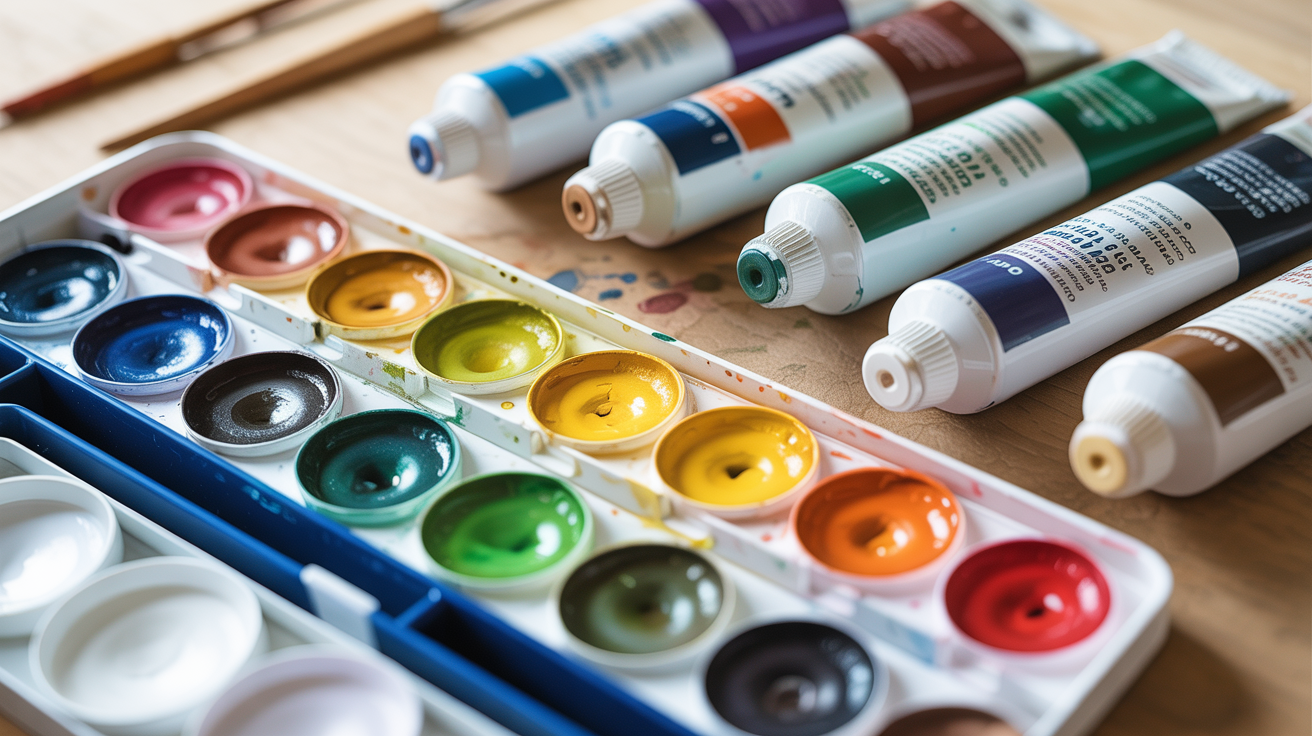
If you're standing in the art supply aisle wondering whether to grab a set of little half-pans or squeeze out some tubes, you're not alone. It's one of the first decisions every new watercolorist faces, and the good news is that neither choice is wrong. They just suit different situations. Here's a plain-language breakdown so you can pick what fits your setup and get painting.
What are tubes and pans, exactly?
Watercolor paint is watercolor paint. The pigment, the binder (usually gum arabic), and the water-soluble chemistry are the same whether the paint ships in a metal tube or a pressed dry cake. The format is about convenience and workflow, not quality.
Tubes
Tubes look like tiny toothpaste containers. You squeeze a small amount of fresh, moist paint onto your palette, then dilute it with water from there. A standard tube is 5 ml or 14 ml. The paint comes out soft and creamy, already at a workable consistency.
Pans
Pans are small cakes of dried watercolor. Half-pans are the most common beginner size (roughly 1.5 x 1.9 cm). You activate them by wetting your brush and scrubbing the surface to pick up pigment. A full pan is twice the volume of a half-pan, and some manufacturers sell whole sets in tidy folding palettes.
The honest comparison
Here's how the two formats compare on the things that actually matter when you're starting out.
| Factor | Tubes | Pans |
|---|---|---|
| Setup time | Longer (squeeze, wait to dry slightly) | Faster (open and paint) |
| Travel-friendliness | Awkward (tubes can leak) | Excellent (compact sets fit in a pocket) |
| Cost per ml of paint | Lower for the same grade | Higher per equivalent volume |
| Fresh, juicy washes | Easier right from the tube | Requires extra rewetting |
| Mixing large areas | Much easier | Can be slow for covering big washes |
| Portability | Fair to poor | Very good |
| Keeping pigments separate | Up to you (palette layout) | Pre-organized in the set |
| Drying out | Tubes seal; dried flecks on palette are wasted | Pans dry by design; no waste |
The bottom line: tubes give you more paint for your money and make it easy to mix large, fluid washes. Pans are compact and fast to pick up and paint.
When pans make sense
Pans are genuinely great for certain situations. If you want to paint outdoors, on a lunch break, or anywhere away from a flat table, a small pan set is hard to beat. You open the lid, add water, and you're painting in under a minute. There's no squeezing, no worrying about tubes rolling away, and the built-in palette lid is usually sufficient for simple mixing.
A set like a half-pan 12-color field kit is also a low-stakes entry point. The paint is already chosen for you, everything is contained, and you don't need a separate palette. That convenience has real value when you're just getting started and don't yet know which colors you use most.
The one frustration with pans (especially cheaper sets) is rewetting. A stiff, dried cake takes real scrubbing to activate, and if your brush pressure is uneven you'll end up with streaky color. Letting a drop of water sit on each pan for a minute before you start solves most of this.
When tubes are worth the setup
Tubes come into their own when you need fluid, creamy washes over a larger area. For a wet-into-wet sky or a loose background that covers most of a sheet, you need a lot of pre-mixed paint ready to go. Squeezing out a pea-sized amount of ultramarine and diluting it to a tea consistency on your palette is fast; scratching that much pigment off a dried pan is tedious.
Tubes are also more economical if you paint regularly. A 14 ml tube of a pigment you reach for constantly (burnt sienna, ultramarine, or quinacridone rose are common workhorses) costs much less per milliliter than buying that color in a replacement pan.
One good habit: squeeze a fresh ribbon of color onto your palette at the start of a session, let it skin over slightly, then paint. If you squeeze directly onto a wet puddle you'll dissolve paint you can't control. For more on building a beginner's palette that works with both formats, the guide on student vs. artist grade watercolor walks through which pigments are worth buying up.
What about quality? Student grade vs. artist grade applies here too
Regardless of whether you choose tubes or pans, the quality of the paint matters more than the format. Student-grade paints (Cotman, Van Gogh, Sakura, Koi) use hue replacements and fillers to keep costs down. Artist-grade paints use single pigments and higher pigment loads.
For beginners, a set of student-grade pans is a fine starting point. But if you find yourself fighting muddy mixes or colors that look dull even when wet, the paint is often the culprit, not your technique. One common upgrade: keep a few artist-grade tubes of your most-used colors (ultramarine, burnt sienna, and one bright like hansa yellow or quinacridone rose) even if the rest of your kit is student grade. These three mixed together cover an enormous range.
Transparent pigments like ultramarine and quinacridone rose layer beautifully without going opaque. Granulating pigments like ultramarine and cerulean add texture as they settle. Both behaviors come through better in artist-grade paint.
Practical advice for choosing your first setup
Here's a simple decision tree:
- You want to paint at home, on a desk, with no plans to travel with your kit: start with a small set of student-grade tubes (6-12 colors) and a basic palette with mixing wells.
- You want to sketch on location, in sketchbooks, with minimum setup: grab a compact half-pan field set.
- You already have pan sets and feel limited: buy a few individual artist-grade tubes of your most-used colors and squeeze them into empty half-pans or onto a covered palette.
- Budget is very tight: a set of 12 student-grade pans is the lowest barrier to entry that still gives you usable color.
Whichever direction you go, make sure you have decent paper underneath your paint. Student-grade paper (copy paper, construction paper, cheap sketchbooks) will buckle, pill, and fight your washes no matter how good the paint is. 140 lb (300 gsm) cold-press paper is the standard for a reason: it holds water, accepts rework, and doesn't distort badly.
Setting up your palette for either format
If you go with tubes, you'll need a separate palette. Any white plastic palette with wells works. Squeeze small amounts around the outer edge, leaving the center open for mixing. Let the paint dry slightly between sessions rather than sealing fresh wet paint in, which can go moldy.
For brushes, a round size 8 or 10 is the best all-rounder for most beginners. It holds enough water for a wash and comes to a point for detail. A 1-inch flat is useful for large areas. The guide to choosing your first watercolor brushes covers what to look for without overspending.
If you go with pans, most sets come in a palette with a lid. Before you paint, open the set and put a drop of water on each pan. Let it soak for a minute. Then your brush will pick up pigment smoothly instead of sliding over the surface.
Two water jars are always better than one: one for rinsing your brush, one kept clean for mixing. It keeps your colors from getting muddy.
Frequently asked questions
Can I mix tubes and pans in the same painting session?
Absolutely. Many painters keep a pan set for convenience and supplement with tubes when they need a large wash or a specific color. There's no rule that says you can only use one format at a time.
Can I fill empty pans with tube paint?
Yes, and this is a great option. Squeeze tube paint into empty half-pans, let them dry completely (usually 24-48 hours depending on humidity), and you have the convenience of pans with the pigment load of tubes. Keep a small label with the pigment name on the back so you don't forget what's in each one.
Do pans dry out permanently?
No. Dried pan paint reactivates easily with water. That's the whole point of the format. Even a pan that's been sitting for months or years will come back to life. Some granulating pigments like ultramarine or cerulean may crack slightly when very dry, but they still work fine once wet.
Are tubes better for large paintings?
Generally yes. If you're working on a half-sheet (15 x 22 inches) or larger and need consistent, fluid coverage, you want to pre-mix a generous puddle of color. Tubes make that easier. Trying to scrub enough pigment off pans for a big wet-into-wet wash is frustrating and slows you down at the worst moment (when the paper is still wet and the clock is ticking).
Which format do professional watercolorists use?
Both, and often in the same kit. Many painters keep a small pan set for travel and reference and use tubes in the studio for larger work. The format that experienced painters prefer is the one that fits the situation, not a matter of professional credibility. Start with whichever appeals to you and adjust as you learn what you actually need.