Washes & Techniques
Wet-on-Dry Watercolor: Crisp Edges and Clean Shapes
Learn the wet on dry watercolor technique to paint crisp edges and clean shapes, with step-by-step guidance for absolute beginners.
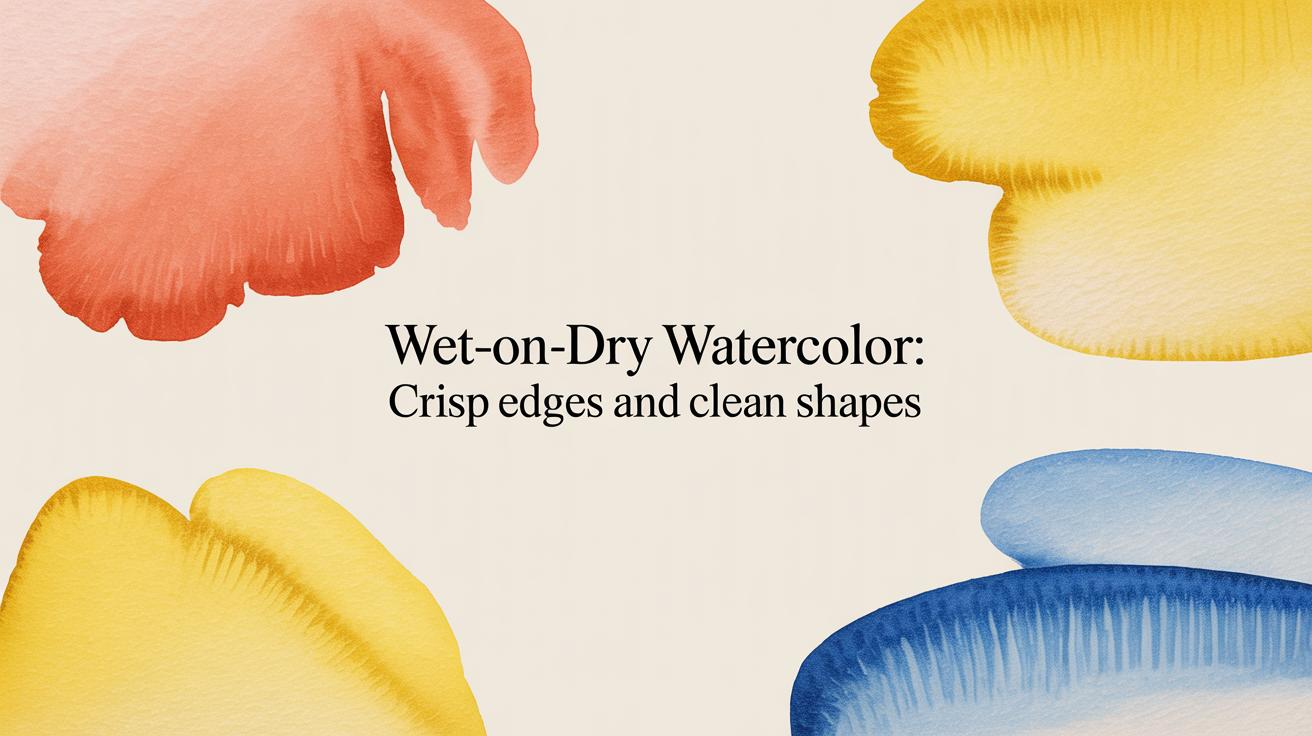
Wet-on-dry is the most controllable technique in watercolor, and it's probably what beginners picture when they imagine painting. You load your brush with color, then apply it to paper that is completely dry. The paint stays where you put it. Edges form wherever pigment meets dry paper, and they stay sharp.
That predictability is a gift, especially early on. Once you understand wet-on-dry, you can start building structured paintings with defined shapes, layered shadows, and clean geometric forms. It's the backbone of architectural sketches, botanical illustration, and any subject where precision matters more than looseness.
What wet-on-dry actually means
"Wet" refers to your loaded brush. "Dry" refers to the paper surface. When both are wet, you get soft, blurring edges (that's wet-on-wet watercolor). When your brush carries paint onto bone-dry paper, the stroke holds its shape and dries with a defined edge.
The key variable is the paper surface. Even slightly damp paper will cause a stroke to bloom outward at its edges, which can feel like a mistake if you expected a hard line. Patience matters here. If you painted a wash five minutes ago, let it dry fully before going back in. A hairdryer on low heat can speed this up, but keep it moving so you don't warp the paper.
Hard edges are not always desirable across a whole painting, but they're essential for showing form, contrast, and structure. A flower petal where the edge is crisp reads as distinct from the petal beside it. A building facade with defined windows and ledges looks solid. Knowing how to produce a reliable hard edge gives you one half of the soft/hard vocabulary that makes watercolor paintings interesting.
How to set up for wet-on-dry work
Start with good paper. 140 lb (300 gsm) cold-press watercolor paper holds up to multiple layers without buckling badly and gives you a slightly textured surface that grips pigment well. Hot-press paper is smoother and produces even crisper edges (it's popular for botanical work), but beginners often find it harder to control because paint puddles rather than sinking in. Stick with cold-press until you feel comfortable.
Keep two jars of clean water handy: one for rinsing your brush, one for mixing. Dirty rinse water makes muddy colors fast.
For brushes, a size 8 or 10 round brush handles most wet-on-dry work. The point gives you control at the edge of a shape, and the belly holds enough paint for a smooth stroke across a larger area. A smaller size 4 or 6 round is useful for tight details and narrow lines.
Mixing your paint to the right consistency
Paint consistency determines how a stroke behaves on dry paper.
- Thin (tea consistency): Very dilute, mostly water. Produces pale, transparent glazes. Great for first layers and building tonal depth gradually.
- Medium (milk consistency): A balanced mix. Most wet-on-dry work happens here. Flows smoothly off the brush, dries with noticeable color.
- Thick (coffee or cream consistency): Less water, more pigment. Produces rich, saturated strokes and very visible edges. Good for final dark accents.
Mix more paint than you think you need. Running out of a color mid-stroke and then scrambling to remix the same shade is one of the most common beginner frustrations. Mix in the well of your palette or a small ceramic dish, and mix generously.
Painting crisp edges: the core skill
Crisp edges come from one thing: your paper must be completely dry when you apply a new stroke. That's the whole rule. Everything else is refinement.
Here are the practical habits that keep edges clean:
- Wait for the sheen to disappear before you paint over a previous layer. A surface that still looks slightly glossy is not dry.
- Load your brush fully, then touch the tip to a paper towel once to remove excess drip. A dripping brush causes edges to flood.
- Paint with confidence. A stroke placed slowly and hesitantly tends to produce a wobbly edge. A decisive stroke placed at a reasonable pace stays cleaner.
- Stop before you overwork. Scrubbing back into a damp layer destroys the edge and lifts pigment. Paint it, leave it.
Practice this on scrap paper before it matters. Paint a square of ultramarine (a granulating pigment that shows texture beautifully on cold-press). Let it dry completely. Then paint a second square overlapping the first. The line where the two meet should be a hard, clean edge. If it's blurry, the surface was still damp.
Building up layers
Layering is where wet-on-dry gets interesting. Because each layer sits on completely dry paper, you can stack them like transparent film, darkening shadows, shifting colors, and adding detail.
A few things to keep in mind as you layer:
Watercolor dries 20 to 30 percent lighter than it looks when wet. This consistently surprises beginners. Paint a stroke, watch it, and when it dries it looks washed out compared to the wet version. The fix is to go slightly darker than you think you need, and to build depth through layers rather than trying to nail the final value in one pass.
Work light to dark. Always. Once pigment is down, you can't take it back reliably. Start with your lightest values and add layers to build shadow and richness.
Transparent pigments layer beautifully without turning muddy. Quinacridone rose, phthalo blue, and sap green are all highly transparent. Cadmium yellow and cerulean are more opaque and can look chalky when layered heavily. Knowing your pigments' properties helps you plan layers that stay clean rather than becoming grey and overworked.
Comparing wet-on-dry and wet-on-wet
These two techniques are not competitors. They're tools you use for different parts of the same painting.
| Wet-on-dry | Wet-on-wet | |
|---|---|---|
| Paper surface | Completely dry | Damp or wet |
| Edge quality | Hard, defined | Soft, blooming |
| Control level | High | Low to medium |
| Best for | Shapes, layers, detail | Skies, backgrounds, soft light |
| Risk | Stiff, overworked look | Color runs too far |
Many paintings use both. You might paint a soft sky using wet-on-wet, let it dry, then paint the rooftops and chimneys against it using wet-on-dry to produce the crisp contrast between building and sky.
A simple wet-on-dry exercise
This exercise takes about 20 minutes and teaches the core skill directly.
You need: cold-press paper, a size 8 round brush, and two colors (ultramarine blue and burnt sienna work well because they're complementary and both widely available).
- Paint a simple flat rectangle of ultramarine diluted to a medium milk consistency. Keep the edges as straight as you can. Let it dry completely.
- While it dries, mix a slightly darker batch of the same blue (less water this time).
- Once the first rectangle is dry, paint a second rectangle overlapping the bottom half of the first. You should now see three zones: the darker second layer, the lighter overlap where the two layers stack, and the original pale single layer.
- Let everything dry, then use burnt sienna to paint a few simple geometric shapes that butt up against or overlap the blue areas.
You're not making art yet, you're making controlled marks. Look at every edge when it dries. Are they crisp? If some are soft, think about whether those sections were truly dry. That feedback loop is the whole lesson.
For more on how to build the underlying wash layers that wet-on-dry sits on top of, see how to paint a flat wash in watercolor and how to paint a smooth graded wash.
Common mistakes and how to fix them
Edges that bloom instead of staying crisp. The paper was damp. Slow down. Touch the paper lightly with the back of your hand. If it feels even slightly cool, it's still evaporating moisture. Wait another minute.
Colors that look muddy after layering. Either the pigments are fighting each other chemically (some combinations like phthalo blue over certain earth tones can get greenish-grey), or you applied too many layers before letting things dry. Limit yourself to two or three layers over the same area.
Brushstrokes that look choppy and visible. This usually means you ran out of paint partway through a stroke. Load the brush more generously and try again. Also check your mixing consistency: too thick and the stroke drags.
Hard edges where you didn't want them. A loaded brush set down and then left stationary will dry with a hard edge exactly where the wet paint stopped. If you're doing a large wash and need to work wet into wet, work faster and keep the leading edge wet until you're done. Otherwise, a hard edge will form at every pause.
Frequently asked questions
How do I get perfectly straight edges without masking tape?
You don't need tape for most shapes. The key is a confident, single-direction brushstroke and a well-pointed brush. For architecture or geometric work, some painters use masking fluid (liquid frisket) to protect straight white lines, or lightly pencil the boundary first and paint carefully up to it. Tape works too, but lift it slowly at a low angle once the paint is bone dry to avoid tearing the paper surface.
Can I use wet-on-dry for skin tones and portraits?
Yes, and it's a common approach. Portrait watercolorists often build skin tones in layers: a warm pale wash of raw sienna or diluted quinacridone rose, dried fully, then cooler shadows in layers of ultramarine or violet. Each layer needs to be completely dry before the next, and keeping the layers thin and transparent prevents the chalky muddiness that plagues overworked portrait work.
How long should I wait between layers?
Long enough for the sheen to disappear entirely and the surface to feel room temperature when you hover your hand close without touching. On 140 lb paper under normal room conditions, a thin wash can dry in 5 to 10 minutes. A heavily loaded area can take 15 to 20. A hairdryer on low from about 10 inches away cuts this significantly, but move it constantly to avoid hot spots that cockle the paper.
What's the difference between a hard edge and a back-run?
A hard edge forms at the border of a painted stroke on dry paper. A back-run (also called a bloom or cauliflower) happens when wet paint is added to a wash that is partially dry but not fully dry. The new wet paint pushes the existing pigment outward into an irregular, hard-edged ring. Back-runs are a mistake if you didn't want them, but some painters use them deliberately for texture in foliage or clouds. To avoid them: either paint into truly wet paint (full wet-on-wet) or wait until everything is bone dry (true wet-on-dry).
Does the type of watercolor paper change how hard edges look?
Quite a bit. Hot-press paper (smooth surface) produces the sharpest, cleanest edges because there's little texture to diffuse the pigment. Cold-press gives slightly softer, more textured edges that look natural for most subjects. Rough paper breaks up edges even more. For crisp architectural work or lettering, hot-press is worth trying. For landscapes and general practice, cold-press is the better starting point.