Materials & Tools
Student vs Artist Grade Watercolor: What's Worth It for Beginners
Choosing between student vs artist grade watercolor? Here's what actually differs, and which one is worth buying when you're just starting out.
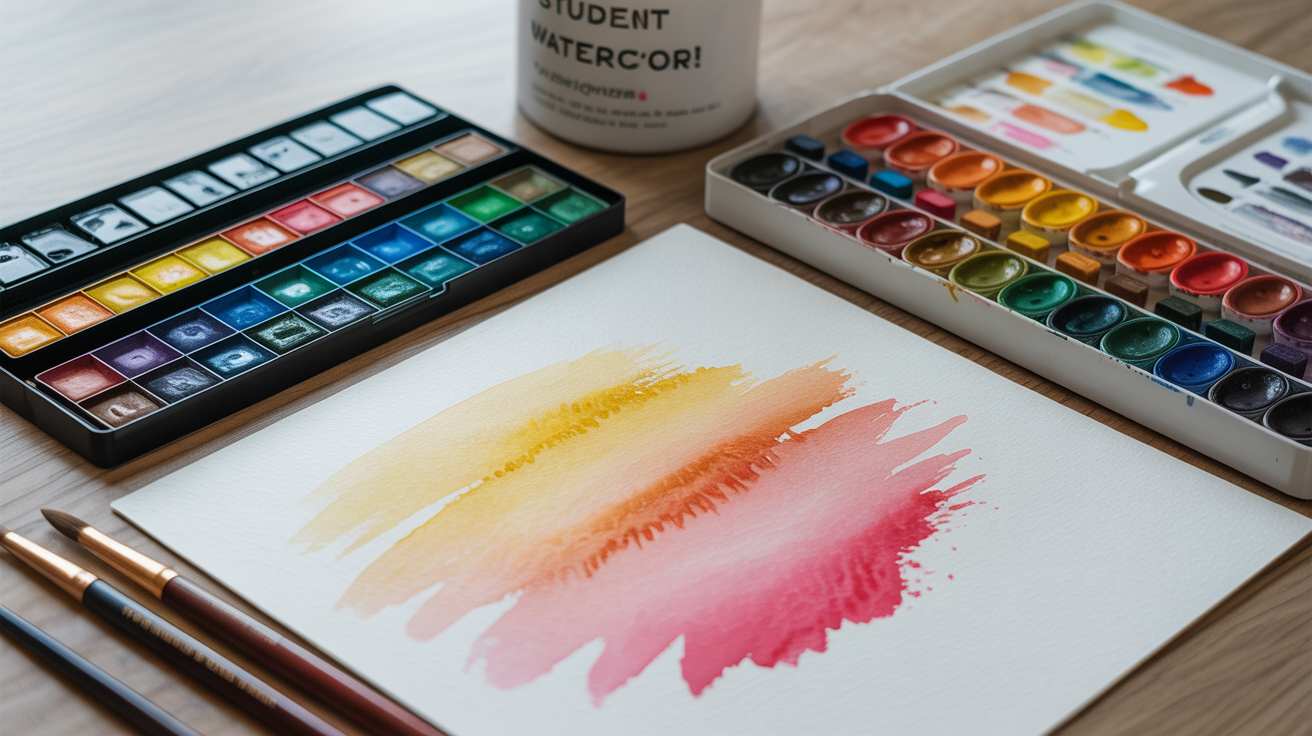
If you're shopping for watercolor paints and feeling lost in the options, you're not alone. The gap between student grade and artist grade paint is real, but it doesn't mean beginners should automatically buy the cheap stuff or splurge on the premium line. The right choice depends on where you are in your practice right now, and this guide will help you figure that out.
At a Glance
- The real difference is pigment load and filler, not marketing. Artist grade uses more pigment and fewer fillers like dextrin.
- Student paints often blend two to four cheaper pigments to imitate one expensive color; artist paints usually use one or two.
- Lightfastness ratings (I through V, or the older Blue Wool scale) tell you how much a color will fade over years of light exposure, buy Series I or II colors.
- Student grade is genuinely fine for learning fundamentals; the gap matters most for glazing, lifting, and clean color mixing.
- A practical middle path: keep a student set for practice, add 6-8 single-pigment artist tubes for work you care about.
- Check the pigment code on the tube (like PB29) rather than the color name; the code tells you exactly what's inside.
What actually separates the two grades
The difference comes down to three things: pigment concentration, the number of pigments in each color, and the use of fillers.
Artist grade paints use more pigment per tube and fewer (or no) fillers. That means richer color, stronger tinting strength, and better lightfastness (how well a color holds up to light over time). Each color in an artist line typically contains one or two pigments. You'll see this listed as "PB29" for ultramarine blue or "PR122" for quinacridone rose on the tube label.
Student grade paints dilute the pigment with fillers like dextrin, which stretches the paint further but reduces intensity. According to pigment researcher Bruce MacEvoy's analysis of watercolor manufacturing, poster paints, student paints, and gouache typically "contain much higher quantities of dextrin than professional grade watercolors," and that higher filler content is what produces the duller, more matte finish many student colors have when they dry. Many student colors also mix multiple cheaper pigments together to imitate a more expensive one. Cadmium yellow in a student set, for example, is often a mixture of yellow pigments rather than actual cadmium.
Neither of these facts makes student paint worthless. It just means you'll sometimes notice muddy mixes or colors that look a bit flat on paper.
How this plays out on paper
Here's the comparison that actually matters when you're painting:
| Feature | Student grade | Artist grade |
|---|---|---|
| Pigment load | Lower (more filler) | Higher (more pigment per ml) |
| Pigments per color | Often 2-4 mixed pigments | Usually 1-2 single pigments |
| Lightfastness | Variable, often weaker | Usually rated I or II (excellent to very good) |
| Transparency | Can be muddier | Cleaner, often more transparent |
| Rewettability | Decent | Generally better |
| Price per tube | Low | 2-5x more |
| Best for | Learning, practice, experimenting | Finished work, serious study |
The transparency difference is worth noting. Some of the most beautiful watercolor effects, like glazing one wash over a dry layer to deepen color, work best with transparent single-pigment paints. A student phthalo blue will glaze reasonably well. A student "Prussian blue hue" made from several mixed pigments may not.
Lightfastness: the number that actually protects your work
Lightfastness is worth understanding on its own, because it is the one quality difference you cannot see on the day you buy the paint. It only shows up years later. The standard framework is the ASTM lightfastness scale, which runs from I (excellent) to V (very poor), and corresponds roughly to the older Blue Wool textile scale used to test dye fading. A color rated Blue Wool 7-8 (ASTM I) can hold up under normal gallery lighting with UV protection for over a hundred years. A color rated Blue Wool 2 can visibly fade within two to fifteen years under the same conditions.
Most reputable artist grade lines print a lightfastness rating directly on the tube or in their published color charts. Student grade lines are inconsistent about this, some publish ratings, many don't. If you're painting something you want to last (a gift, a piece for a wall, anything you'd frame), checking for a Series I or II rating before you buy matters more than the brand name on the label.
The case for starting with student grade
Student grade paint is not a dead end. Painters have produced stunning work with Cotman, Van Gogh, and Sakura Koi, and those sets are genuinely good for learning. When you're working through your first sketchbook or practicing wet-on-wet on a piece of scrap paper, the difference between student and artist grade matters a lot less than developing hand control and color intuition.
The practical argument is also straightforward: if you're mixing colors freely, trying things out, and not worrying about whether a piece will last 50 years, student grade is fine. You can buy a 12-pan Cotman set for around $15 and have everything you need to learn fundamental techniques.
Where student grade starts to feel limiting is when you want clean, transparent shadows, or when you're trying to understand color mixing. A student yellow mixed with a student blue can produce a green that looks a little brownish or dull because of the hidden extra pigments. If you're struggling to get the mixes you're seeing in tutorials, the paint quality might be a factor.
The case for buying a few artist grade tubes
You don't have to choose one or the other across the board. A practical middle path: keep your student grade set for practice and build a small palette of artist grade single-pigment colors for painting you actually care about.
A starter artist palette of 6-8 tubes covers most of what you need:
- Ultramarine blue (granulating, transparent, great for skies and shadows). Ultramarine's pigment code is PB29, and its particles are naturally coarser and less uniform than most synthetic pigments, which is exactly why it settles into paper texture and granulates instead of drying flat.
- Phthalo blue green shade (intense, transparent, powerful mixer)
- Burnt sienna (warm, semi-transparent, pairs beautifully with blues)
- Raw sienna (softer yellow-brown, good for earthy tones)
- Quinacridone rose or quinacridone magenta (clean, transparent, not muddy)
- Hansa yellow medium or new gamboge (clear, warm yellow)
- Payne's grey (granulating, useful for darkening mixes without going black)
- Sap green (optional, saves mixing time for foliage)
These 7-8 tubes from a brand like Winsor & Newton Professional, Daniel Smith, or Schmincke Horadam will run you $50-90 total. You don't need to replace your student set, just supplement it. Read more about choosing individual tubes vs. a ready-made set to figure out the best format for your budget.
Is artist grade watercolor worth it for beginners?
The honest answer is: partially, and strategically. Buying a full professional set of 24+ artist grade pans before you've painted 20 pieces is probably overkill. The beginner who buys a $200 professional set and the one who buys a $20 student set will not produce dramatically different work in their first three months. Skill matters more than supplies at that stage.
That said, there are specific cases where artist grade paint pays off even early on:
- If you're working on paper you love (good 140 lb / 300 gsm cold-press paper deserves good paint)
- If you want to understand color theory and clean mixes, because single-pigment paints are much more predictable
- If you're painting cards, small gifts, or anything you want to last
- If you find student paint frustrating rather than liberating
One good move is to buy a single tube of artist grade ultramarine blue and paint the same sky wash with it and with your student blue. The difference in granulation and glow will tell you more than any review. Your paper choice matters here too, since better paper shows off good paint. See watercolor paper explained: cold press, hot press, and rough if you're not sure what you're painting on.
What to look for on the label
At either grade level, a few label details are worth checking:
- Pigment code (P number): Paints labeled "PB29" contain a single pigment. Paints that list no P number, or three or four of them for one color, are mixed and less predictable.
- Lightfastness rating: Look for I (excellent) or II (very good). A rating of III or "fugitive" means the color will fade over time.
- Series number: Artist grade paints are priced by series (1 through 4 or more). Series 1 colors like raw sienna and yellow ochre are usually affordable. Series 4 colors like genuine cadmiums are expensive. Stick to series 1-2 when building your first palette.
Getting comfortable with reading these labels is part of developing your eye as a painter. You don't have to memorize every pigment, but knowing what's in your tube helps you understand why a color behaves the way it does. Good brushes also make a big difference in how paint flows and how much control you have. Take a look at how to choose your first watercolor brushes once your paint questions are settled.
Frequently asked questions
Can you mix student and artist grade paints on the same palette?
Yes, completely. Most painters do this without any problems. The paints are chemically compatible. The only thing to be aware of is that artist grade colors tend to be much more concentrated, so a small amount goes a long way. If you're mixing a student grade color with an artist grade one, start with less of the artist grade pigment than you think you need.
Does student grade paint dry darker or lighter than artist grade?
Both grades dry lighter than they look when wet, usually 20-30% lighter. This is a fundamental watercolor behavior, not a quality issue. The effect can feel more pronounced with student grade paints because the lower pigment load means the final dry color is less saturated. Either way, practicing on scrap paper and letting a test swatch dry before judging the color is the right habit to build.
Are pan paints or tube paints better for beginners?
Both work fine for beginners. Student grade pans (like Cotman or Koi) are very convenient for sketching outdoors because everything is pre-loaded and compact. Tubes give you fresher, more vibrant paint and are often better for washes on full sheets. If budget allows, tubes give you a bit more flexibility. See the tubes vs pans guide for a full comparison.
Is there a brand that offers something between the two grades?
A few brands sit in the middle. Holbein Artists' Watercolor and QoR are often described as professional quality at slightly friendlier prices. Some artists consider Van Gogh (Royal Talens) a strong step-up option from Cotman, using single pigments in most colors while staying well below top-tier pricing. It's worth looking at individual tube reviews for the specific colors you need rather than comparing whole lines.
When should I upgrade from student to artist grade?
There's no fixed point, but a few signs suggest you're ready: you've filled at least one sketchbook, you're starting to want cleaner color mixes than you're getting, or you're painting pieces you want to keep. You don't have to upgrade all at once. Replacing one student color at a time with a quality single-pigment alternative is a sensible way to learn what each paint actually does.
Does a higher price always mean a better lightfastness rating?
Not necessarily, and this trips people up. Price mostly tracks raw material cost, genuine cadmiums and cobalts are expensive because the pigments themselves are expensive, not because they're better made. Some inexpensive earth pigments (raw sienna, yellow ochre) have excellent, rock-solid lightfastness at a low price. Always check the printed rating on the tube rather than assuming cost and permanence move together.