Light, Value & Composition
Soft vs Hard Edges in Watercolor and When to Use Each
Learn how soft and hard edges watercolor work together to create depth and focus in your paintings, with beginner-friendly techniques and examples.
Edge control is one of those things no one tells beginners about, yet it changes everything about how a painting reads. A hard edge makes something pop forward. A soft edge lets it drift back into the light or atmosphere. Learning when to use each gives your work a sense of air and intention that pure color mixing cannot.
At a Glance
- Edges are decided by wet-versus-dry, not by brush skill: paint into dry paper for hard edges, into wet paper for soft ones.
- Hard edges pull the eye forward; soft edges push things back into space or atmosphere.
- "Lost and found" edges (some crisp, some dissolved) create rhythm and keep a painting from looking flat and outlined.
- You have roughly 30 to 60 seconds to soften a fresh stroke before it sets past the point of easy blending.
- A rough guideline many painters use: about two-thirds soft or lost edges, one-third hard, concentrated at the focal point.
- Backruns ("cauliflowers") happen when you touch a partly-dry edge; leave it alone once the sheen starts to fade.
What edges actually are
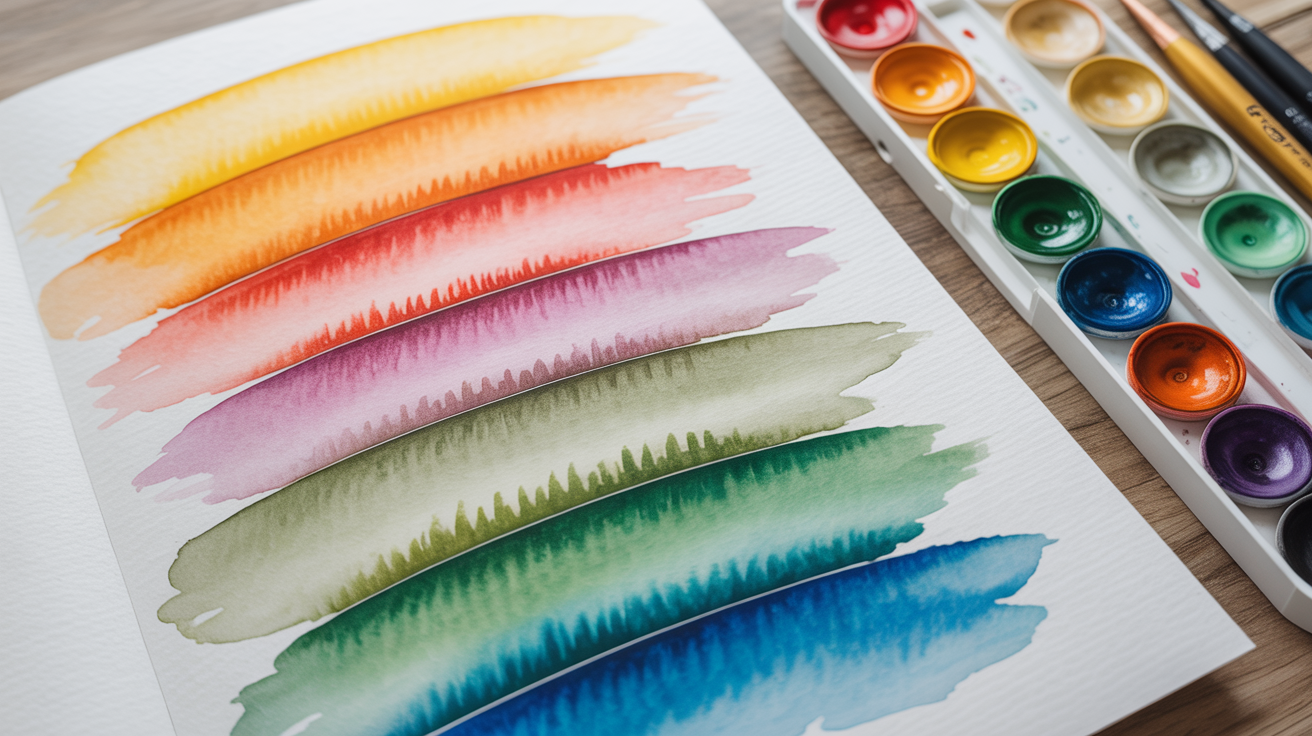
Every shape in a painting has a boundary. That boundary can be sharp and definite, or it can blur into the surrounding area. In watercolor, the type of edge you get depends almost entirely on whether the neighboring paint is wet or dry when you apply the next stroke.
Hard edges form when you paint onto dry paper or a dry layer. The paint settles where you put it, and when it dries the outline stays crisp. A petal placed against a dry background, a dark mountain ridge against a pale sky, a shadow on a white cup: these all want a hard edge because they are distinct, clearly lit objects.
Soft edges form when you paint into wet paint, or when you soften a fresh stroke with a damp brush before it dries. The colors bleed into each other and the boundary between them blurs or disappears. This happens because water moves through paper fibers on its own once two wet areas meet. Capillary action pulls liquid sideways through the tiny gaps between fibers, which is exactly why pigment dropped into a damp area spreads and softens rather than sitting still the way it would on dry paper. Fog, hair, clouds, cast shadows that gradually fade, the far edge of a rounded object catching reflected light: these all call for soft edges because the transition between them and their surroundings is gradual in real life.
A third type: the lost edge
Artists also talk about "lost and found edges." A lost edge is simply a soft edge taken to its furthest point, where a shape seems to dissolve almost entirely into the background. Think of a white flower petal lit from above, where the top of the petal and the white paper are the same value and there is almost no visible edge at all. Finding some edges and losing others in the same painting creates rhythm. It keeps the eye moving and gives the painting a sense of light rather than a diagram-like outline of every object.
How to make a hard edge
Nothing to it: paint on dry paper or a completely dry layer. Use enough pigment and keep your stroke confident. If you slow down or go back into a drying edge while it is still damp, you risk a backrun (sometimes called a "bloom" or "cauliflower"), where water pushes the pigment outward in an uneven ring. That happens because the fresh, wetter paint you add finds less resistance than the semi-set paint around it, so capillary movement pulls pigment toward the new water instead of staying put. That can be useful as a texture, but if you did not want it, it means the paint was not dry enough.
To test dryness, hold the paper at an angle to a light source. Wet paint has a sheen. When the sheen is gone, you are safe to paint over it.
How to make a soft edge
There are two main approaches.
Wet-on-wet. Wet the area with clean water first, then drop paint into it. The pigment spreads on its own and the edges are soft by nature. You can also paint one color and immediately run a second color into its wet boundary. This is the technique behind smooth graded washes and blended skies: the sky color fades to pale at the horizon because you are working wet into wet the whole time.
Lifting while wet. Paint a stroke, then pick up a clean, slightly damp brush (not soaking wet, or you will push a backrun) and drag it along the edge you want to soften. The damp brush picks up a little pigment and blurs the line. You have maybe 30 to 60 seconds after the initial stroke before it starts to set, so work quickly.
A round size 8 brush is good for both tasks. Keep a second jar of water just for your softening brush so it stays clean.
A worked example: one shape, three edge treatments
Try this on a scrap of 140 lb cold-press paper to feel the difference directly. Paint a simple circle, roughly 2 inches across, in a mid-value blue.
| Step | Technique | Result |
|---|---|---|
| Left third of the circle | Paint on bone-dry paper, leave it alone | Crisp, hard edge all the way around |
| Middle third | Paint on dry paper, then soften the outer edge with a damp brush within 30 seconds | Soft edge fading into the white paper |
| Right third | Wet the paper first, then drop in the paint | Very soft, diffuse edge with no clear boundary |
Let the whole thing dry and compare the three sections side by side. The middle and right sections will look softer than you expect, and the left section will look sharper than you expect, most beginners underestimate how much contrast a single hard edge creates next to soft ones.
When to use which
The simplest guide is this: sharp contrasts come forward, soft ones recede. But here is a more practical breakdown.
| Situation | Edge type | Why |
|---|---|---|
| Foreground objects, focal point | Hard | Clarity and presence; eye lands here first |
| Sky, atmosphere, distant hills | Soft | Air and distance blur things naturally |
| Shadows on rounded forms | Soft on the far side, hard near the light | Rounded things curve away from the light gradually |
| Cast shadows | Hard where shadow meets light source; softer as it extends | Softer further from the object |
| Hair, fur, loose fabric | Soft (with a few hard accents) | Texture reads as soft, but a few defined strands anchor it |
| Buildings, geometric objects | Hard edges on lit planes, soft or lost on shadow side | Structure reads as solid without being stiff |
| Flowers and petals against dark backgrounds | Mix | Some edges pop, some are lost for realism |
The rule people repeat is "hard edge near the light, soft edge away from it." That holds up about 80% of the time, especially on rounded subjects like fruit, faces, or rocks.
Practical exercises to try
These are short, focused, and cheap on paper. Use scrap 140 lb (300 gsm) cold-press rather than your good sheets.
- Paint a simple circle (a piece of fruit, say) using wet-on-wet for the shadowed half and let the boundary between light and shadow fade on its own. Let dry, then come back with a hard-edged darker stroke on the cast shadow below it.
- Paint two rectangles side by side in the same mid-value. Make the left one have crisp hard edges on all four sides. On the right one, immediately soften all four edges with a clean damp brush. Compare how different they read.
- Do a quick, loose landscape with just three values (light, mid, dark). Make every edge in the sky soft and every edge in the foreground hard. You will see the depth appear without any detail at all.
For this last exercise, doing a brief value sketch beforehand helps you figure out where the focal edges should be before you commit to wet paint.
Common beginner problems with edges
Overworking a drying edge. The biggest cause of muddy, chaotic edges. Once a stroke starts to set (you can see the sheen going), leave it alone. The more you fiddle, the messier it gets. Watercolor rewards patience more than effort.
Making every edge hard. Beginners tend to paint carefully around every shape. The result looks tight and flat, like a coloring book. Try to consciously lose at least a third of your edges in every painting.
Making every edge soft. The opposite problem: everything blurs into everything else and the painting has no focal point, no place for the eye to rest. You need contrast to give soft areas their softness. A single crisp edge next to a lost one makes both more powerful.
Not planning edge type before you start. It is hard to add a soft edge later once things are dry (you can re-wet an area, but you risk disturbing what is already there). Think about which edges matter before you pick up the brush. Knowing in advance that saving a white shape will require a hard edge around it, for example, means you paint around it carefully while the surrounding area is still manageable.
Rushing the softening window. New painters often wait too long to soften an edge, then find the paint has already started to set and dragging a damp brush across it just scuffs the paper. If you know a soft edge is coming, have your damp brush ready before you lay the stroke.
Frequently asked questions
What are lost and found edges in watercolor?
Lost edges are places where a shape's boundary dissolves into the background, usually because the values or colors are very close. Found edges are crisp, visible boundaries. Using both in the same painting makes it feel more alive and less mechanical, because real light rarely outlines everything with equal clarity.
How do I soften an edge that has already dried?
You can re-wet the area gently with a clean brush and then blot or lift slightly, but it is risky and the results are unpredictable. It is almost always easier to plan your soft edges from the start and soften them while the paint is still wet. That said, a very small, damp synthetic brush can coax a softened transition on dried paint if you work gently and the paper is robust.
Does the paper affect how edges behave?
Yes, a lot. Cold-press paper (the standard for beginners) has enough texture to slow spreading and gives you a little time to work. Hot-press is smoother and very unforgiving: paint flows fast and soft edges are harder to control. Rough paper has more tooth and can create interesting broken edges on its own. Stick with cold-press 140 lb until you have a feel for how edges work, then experiment.
Can I use masking fluid to control edges?
Masking fluid reserves hard edges around whites, but it does not help with soft edges. It is a useful tool for preserving sharp whites and highlights, but overusing it makes paintings look mechanical. For most edges, learning to paint around shapes and soften wet paint is a better long-term skill.
How many soft edges should a painting have?
There is no exact number, but a rough guideline that many painters use is to aim for roughly two-thirds soft or lost edges and one-third hard edges. The focal point of the painting gets the sharpest, hardest edges, which naturally draws the eye there. Everything else can afford to be a little looser.
Why does my soft edge turn into a backrun instead of blending smoothly?
This usually means the brush you used to soften was too wet rather than merely damp. A brush loaded with extra water adds more liquid than the drying paint can absorb evenly, so it pushes pigment outward into a ring instead of blending it. Blot your softening brush on a cloth or paper towel until it looks almost dry before you touch the edge, you can always go back for more if the first pass is not soft enough.