Subjects & Projects
How to Paint a Watercolor Sunset for Beginners
Learn how to paint a watercolor sunset step by step. This beginner guide covers colors, wet-on-wet sky technique, and a simple paint-along project.
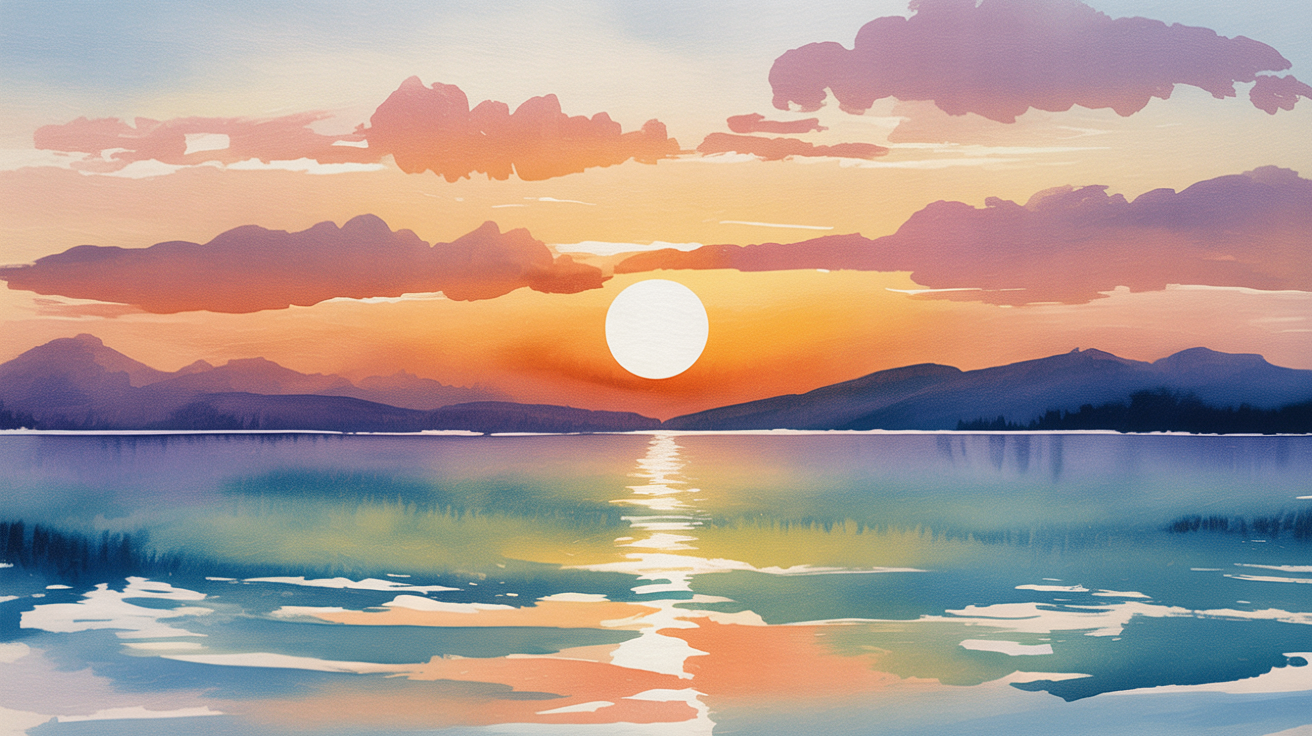
A watercolor sunset might be the single most beginner-friendly subject you can choose. The soft edges, the blending colors, the forgiving sky: all of it suits watercolor's natural tendencies. If you can load a brush and tilt your paper, you can paint one.
This guide walks you through exactly how, from picking the right colors to putting down the final wash. We'll do a simple, paint-along project with numbered steps so you know what to do and when.
What you need before you start
You don't need a lot of supplies, but a few specifics matter here.
Paper. Use at least 140 lb (300 gsm) cold-press watercolor paper. Lighter paper will buckle under the amount of water a sky wash requires, and you'll end up chasing puddles instead of painting. Tape or clip your sheet to a board so it stays flat.
Brushes. A size 10 or 12 round is your main tool for the sky. A size 6 or 8 round handles the horizon details. A 1-inch flat brush is optional but great for laying in big sky washes quickly.
Colors. Sunsets are warm at the horizon and shift to cooler blues overhead. These six pigments cover almost every sunset you can imagine:
| Color | Type | Role in the painting |
|---|---|---|
| Cadmium yellow or hansa yellow | Warm, opaque/transparent | Bright glow near the sun |
| Quinacridone rose | Transparent | Pink-orange mid-sky |
| Burnt sienna | Semi-transparent | Deepening orange at horizon |
| Ultramarine blue | Granulating, transparent | Upper sky, shadow color |
| Cerulean blue | Granulating, soft | Soft blue just above the glow |
| Payne's grey | Transparent | Darkening clouds, foreground silhouettes |
You can simplify to just three: hansa yellow, quinacridone rose, and ultramarine. That's a complete sunset palette on its own.
Two water jars. One stays clean for mixing and brush-loading; the other takes the dirty rinse water. This matters more with sunset colors than almost any other subject because muddy water turns your pinks orange and your oranges brown.
Understanding what makes a sunset look like a sunset
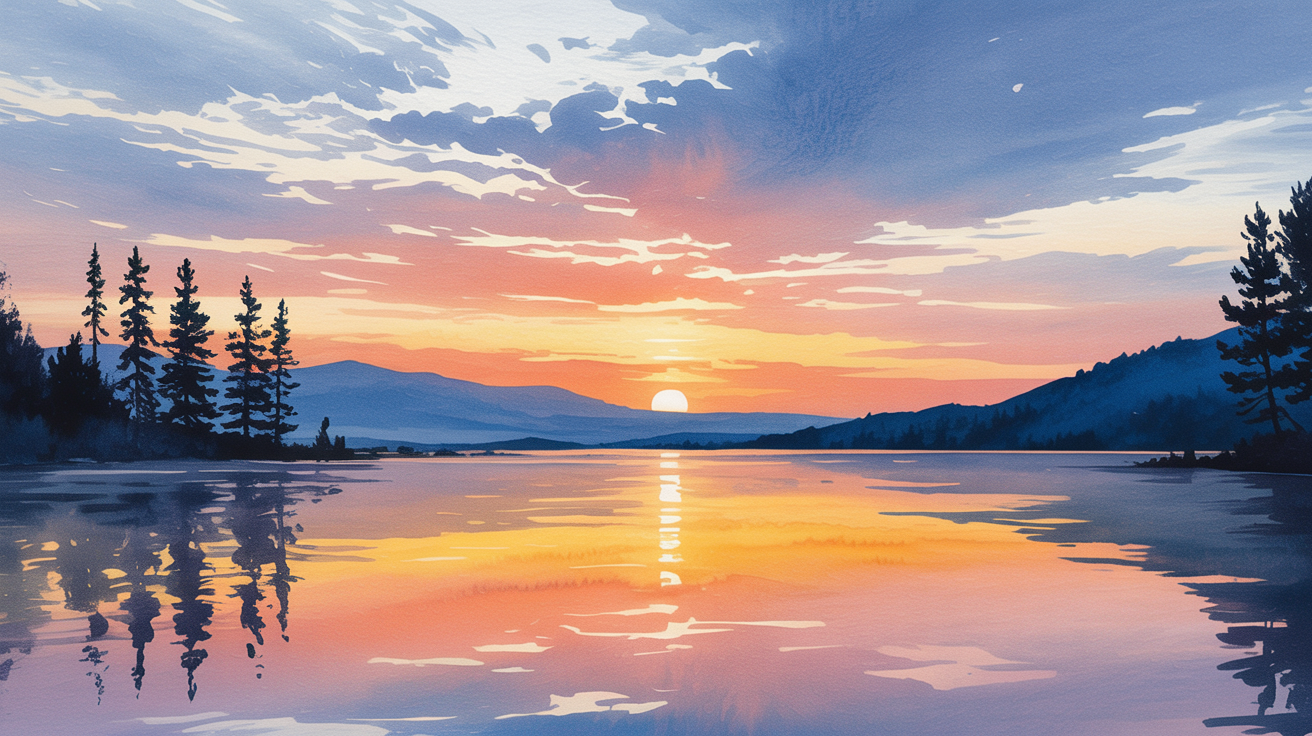
Before you put down a single mark, look at a few reference photos. Notice that sunsets almost always have a specific structure:
- The brightest, most yellow-orange area hugs the horizon right where the sun is (or just set).
- As you move upward, the color shifts through pink and rose, then transitions into a cooler blue or purple.
- The very top of the sky is the deepest blue, often ultramarine or close to it.
- Clouds catch the light from below, so their undersides glow orange or pink while their tops go cooler.
This top-to-bottom gradient is the backbone of the painting. Everything else builds on it.
One thing beginners often miss: watercolor dries 20 to 30% lighter than it looks wet. Mix your colors a little richer than you think you need, especially the sky blues and the deep horizon orange.
The paint-along project: a glowing horizon sky
This project takes about 30 minutes and produces a simple but satisfying sunset sky. It's designed to teach the wet-on-wet technique, which is the standard approach for soft, blended watercolor skies. If you haven't tried wet-on-wet painting yet, the guide on how to paint a simple watercolor sky and clouds covers the basic mechanics well.
Step 1: Prepare your paper and palette
Tape your watercolor paper to a board on all four edges. Tilt the board toward you at about a 10 to 15-degree angle. This gentle slope lets gravity help your colors flow together without running off the bottom.
Mix three pools of color on your palette before you touch the paper:
- Yellow-orange: hansa yellow with a small touch of quinacridone rose, "cream" consistency (just slightly thicker than water)
- Rose-pink: quinacridone rose with a tiny drop of burnt sienna, "milk" consistency
- Upper sky blue: ultramarine blue with a hint of quinacridone rose, "tea" consistency (fairly dilute)
Have all three ready and wet. Wet-on-wet moves fast, and you don't have time to mix mid-wash.
Step 2: Wet the paper
Load your largest round or your 1-inch flat with clean water. Working from top to bottom, wet the entire sky area of your paper with an even coat. You want the surface to glisten uniformly, with no dry patches. Hold the paper up to a light source. If any area looks matte, add more water there.
Let the water sit for 20 to 30 seconds. The surface should look wet but not have standing puddles.
Step 3: Drop in the upper sky blue
Starting at the top of your wet paper, lay in your ultramarine mixture. Use long, horizontal strokes with your loaded size 10 round. Work down about a third of the way and then stop. The color should bleed softly into the wet paper. Don't scrub or push, just let the brush deliver the paint and trust the wet surface to spread it.
Step 4: Add the rose-pink middle zone
Without letting the blue dry, load your brush with the rose-pink mix. Pick up where the blue is thinning and work downward another third. Where the blue and pink meet, they should fuse into a soft purple without you needing to blend them. If the edge looks sharp, your paper may be drying faster than expected. Work quickly.
Step 5: Drop in the yellow-orange at the horizon
Load your brush with the yellow-orange mix and bring it up from the bottom of the sky to meet the rose zone. The warmest color should concentrate at the very bottom of the sky, fading upward into the pink. Let the colors blend where they meet. You can tilt the board slightly to encourage the warm color to pool at the horizon.
At this point, put your brush down. Resist the urge to fuss. Overworking a wet wash is the most common beginner mistake, and it lifts the pigment and turns everything muddy.
Step 6: Let it dry completely
Walk away for at least 20 minutes, or use a hair dryer on the lowest heat setting held at arm's length. The colors will settle, soften, and lighten as they dry. This is normal.
Step 7: Add a simple foreground silhouette (optional)
Once the sky is bone dry, mix a dark value using Payne's grey with a touch of ultramarine. Use your size 6 round to paint a simple tree line or rooftop silhouette along the horizon. A silhouette makes the sky glow by contrast and gives the painting a sense of place. Keep the shapes simple and flat because detail in a silhouette actually weakens it.
For ideas on adding plants or botanical shapes to a foreground, the post on how to paint watercolor leaves and greenery has useful techniques for loose, gestural foliage.
Common problems and how to fix them
The colors went muddy. Usually this means the paper surface dried partially before you finished laying in color, so you started mixing wet-on-dry in the middle of a wet-on-wet pass. Next time, work faster or re-wet the paper. Also check that your water jars are clean.
Hard edges appeared in the middle of the sky. A hard edge (sometimes called a "bloom" or "cauliflower") forms when you drop wet paint into an area that has started to dry. It's a timing issue. Practice wetting the whole paper thoroughly and moving through the colors quickly. Some artists actually like blooms and use them deliberately for cloud texture.
The horizon color isn't glowing. Sunset glow comes from a concentrated warm color at the horizon with a clean transition above it. If yours looks flat, the yellow-orange mix may have been too dilute, or the blue may have bled down too far and contaminated it. Try a stronger concentration of hansa yellow at the bottom and be quicker with the blue so it doesn't drift too far.
The paper buckled anyway. Lightweight paper buckles even when taped. The fix is to stretch your paper before painting: soak it in a bathtub for a few minutes, then staple or tape it to a board while wet and let it dry. Once dry, it won't buckle during painting.
Ways to take this further
Once you've done the basic sky a couple of times, there are a few natural directions:
- Add loose watercolor clouds by lifting wet paint with a dry brush or crumpled tissue while the sky wash is still wet
- Paint a water reflection below the horizon. A reflection mirrors the sky colors but is slightly darker and has horizontal ripple breaks
- Try a different palette. A purple-to-orange sunset uses quinacridone violet instead of cerulean blue for the upper sky
- Add more landscape interest. A simple coastline, a barn roof, or a line of telephone poles against the glow can turn a sky study into a finished painting
If you're interested in doing more complete scenes with foliage, loose watercolor flowers as an easy first project uses a similar wet-on-wet approach in a different subject, and the two skills transfer well to each other.
Frequently asked questions
What colors do I mix to make a sunset?
The core sunset palette is a warm yellow at the horizon (hansa yellow or cadmium yellow), a rose-pink in the middle zone (quinacridone rose), and a blue at the top (ultramarine or cerulean). These three colors are enough for most sunsets. Burnt sienna deepens the orange if you want more intensity near the horizon.
Do I have to use wet-on-wet technique for a watercolor sunset?
No, but wet-on-wet gives you the soft, blended edges that most sunset photos have. If you prefer sharper, more graphic results, you can let each color band dry before adding the next. The edges will be crisper and the result more stylized. Neither approach is wrong.
Why does my sunset look dull after it dries?
Watercolor loses 20 to 30% of its intensity as it dries, so a vivid wet wash often looks underwhelming once dry. The fix is to mix your colors a bit stronger than feels comfortable. With practice you develop an eye for "how dark does this need to look wet to end up right when dry." You can also add a second layer once the first is fully dry to punch up the color.
How do I keep the sun from looking like a white hole?
The simplest technique is to paint around the sun, leaving the white paper as the light source. Wet your paper and keep a small dry area where you want the sun. The wet color will naturally pull away from the dry spot. Alternatively, use masking fluid on the sun before you start and remove it after the sky dries.
Can I use student-grade paints for this?
Yes. Student-grade paints work fine for learning, and a sunset project is actually a good match because you're relying on color mixing and timing more than pigment transparency. The main limitation is that student-grade pigments can be less vibrant and may muddy more easily. If you can, spring for artist-grade quinacridone rose and ultramarine; those two make the biggest difference.